
 Kilimanjaro climbs · 8 days
from Kilimanjaro
Kilimanjaro Climbing MACHAME ROUTE Africa safari
Ask us for a price
Kilimanjaro climbs · from Kilimanjaro
The Marangu or main route is by far the most popular way to the summit of Kilimanjaro. On the way up and down you sleep in mountain huts with all the basic necessities.
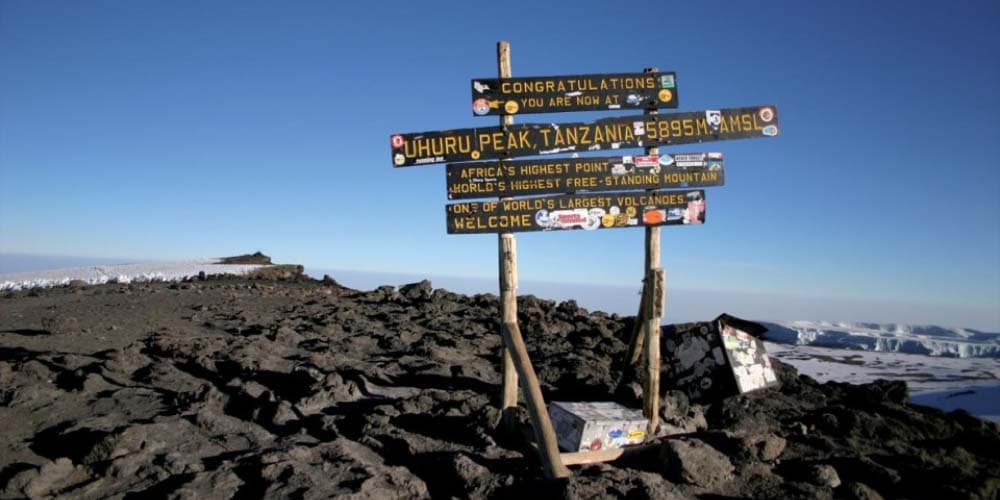
The round trip usually takes 5 days and 4 nights on the mountain: through rainforest to Mandara Hut, up to the moorland of Horombo Hut, across the alpine desert of the saddle to Kibo Hut, and then a night climb to Gillman's Point and Uhuru Peak, the highest point in Africa.
Your days
Pickup from Arusha town or Kilimanjaro International Airport, and transfer to Moshi, known as the gateway to Mount Kilimanjaro.
Overnight at a base hotel in Moshi, on half board.
After breakfast and a short briefing from your guide, drive 45 minutes from Moshi to the Marangu gate of Kilimanjaro National Park.
Once you have registered with the park authorities, the climb begins with a four-hour walk to Mandara, through a thick rainforest zone where there is a high chance of rain in the afternoon.
Overnight at Mandara Hut, an attractive collection of buildings with bathrooms and running water.
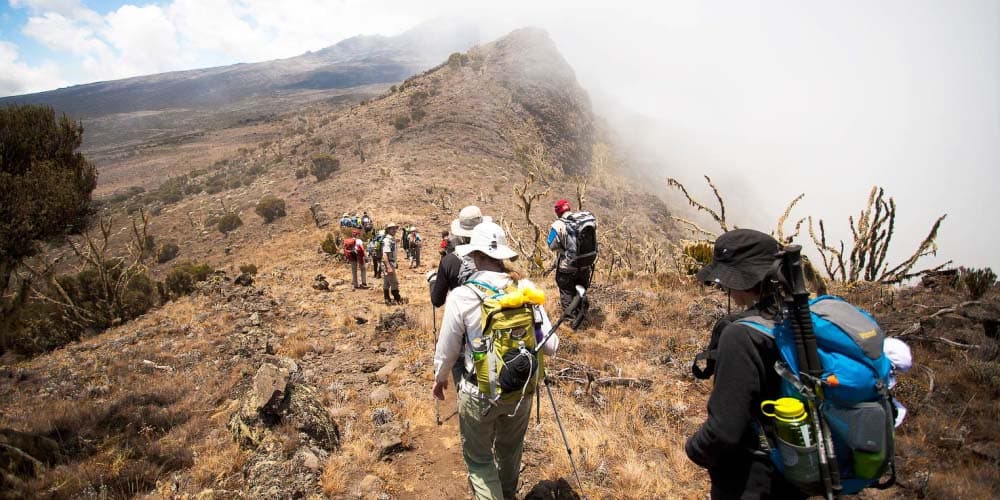
Continue up through the forest for a short time, then into the heather and moorland zone at roughly 3,000 m, on a walk of about six hours. Enjoy stunning views of the mountain peaks at this altitude.
Overnight at Horombo Hut (3,720 m), which lies in a valley surrounded by giant lobelia and groundsel, plants typical of this semi-alpine zone. There are bathrooms with running water.
Walk on past the last watering point and climb onto the saddle of Kilimanjaro, between the peaks of Kibo and Mawenzi. The vegetation thins out as you enter the desert-like alpine zone, at about 4,000 m.
The saddle is an alpine desert that looks like a lunar landscape, and once you cross it, Kibo peak comes into view.
Watch for signs of altitude sickness. This seven-hour walk is taken at a slow pace.
This semi-desert zone gets under 250 mm of rain a year. The ground often freezes at night, but ground temperatures soar above 30°C by day, and few plants other than lichens and grasses survive.
Overnight at Kibo Hut (4,703 m), a comfortable stone building with no running water.
Shortly after midnight, start your climb to the summit. The scree slope up to Gillman's Point on the crater rim is easier to climb while it is frozen, and an early start on this six-hour hike improves your chances of reaching the summit in time for sunrise.
From Gillman's Point, a further two-hour round trip along the crater's edge takes you to Uhuru Peak, the highest point in Africa.
From the summit it is downhill all the way to Horombo Hut, where you spend your last night on the mountain.
Continue down past Mandara to the foot of the mountain, where each hiker receives a well-earned certificate.
Transfer to a base hotel in Moshi for dinner and overnight.
After breakfast, transfer back to Arusha town, where the trip ends.
There is no published price table for this trip yet. Ask us for a price.
Pickup
Tell us where you're staying to see what pickup costs.
A hotel, an area, the airport or the cruise port.
There is no free pickup area yet. Wherever you are staying, our team confirms the pickup after you book.
Keep exploring
Kilimanjaro climbs · 8 daysfrom Kilimanjaro
 Kilimanjaro climbs · 8 days
from Kilimanjaro
 Kilimanjaro climbs · 8 days
from Kilimanjaro